The Ultimate Guide to Soft & Juicy Homemade Meatballs
Cristian
Recipe Developer | 200+ Tested Recipes | Founder of Meatless.io
Published: January 18, 2026 | Updated: January 18, 2026
Here's a confession. I spent years making mediocre meatballs. Dense ones. Dry ones. Ones that somehow tasted like nothing despite being packed with garlic. The thing is, I thought meatballs were simple. Meat, breadcrumbs, egg, seasonings. Roll, cook, done. But that's exactly where most home cooks go wrong.
Perfect meatballs aren't about following a recipe. They're about understanding why certain things work. What I'm giving you here isn't just a recipe. It's the framework I wish someone had handed me fifteen years ago - the physics and ratios that turn decent meatballs into the kind people actually remember.
Choosing Your Meat Blend: The Foundation Nobody Talks About Enough
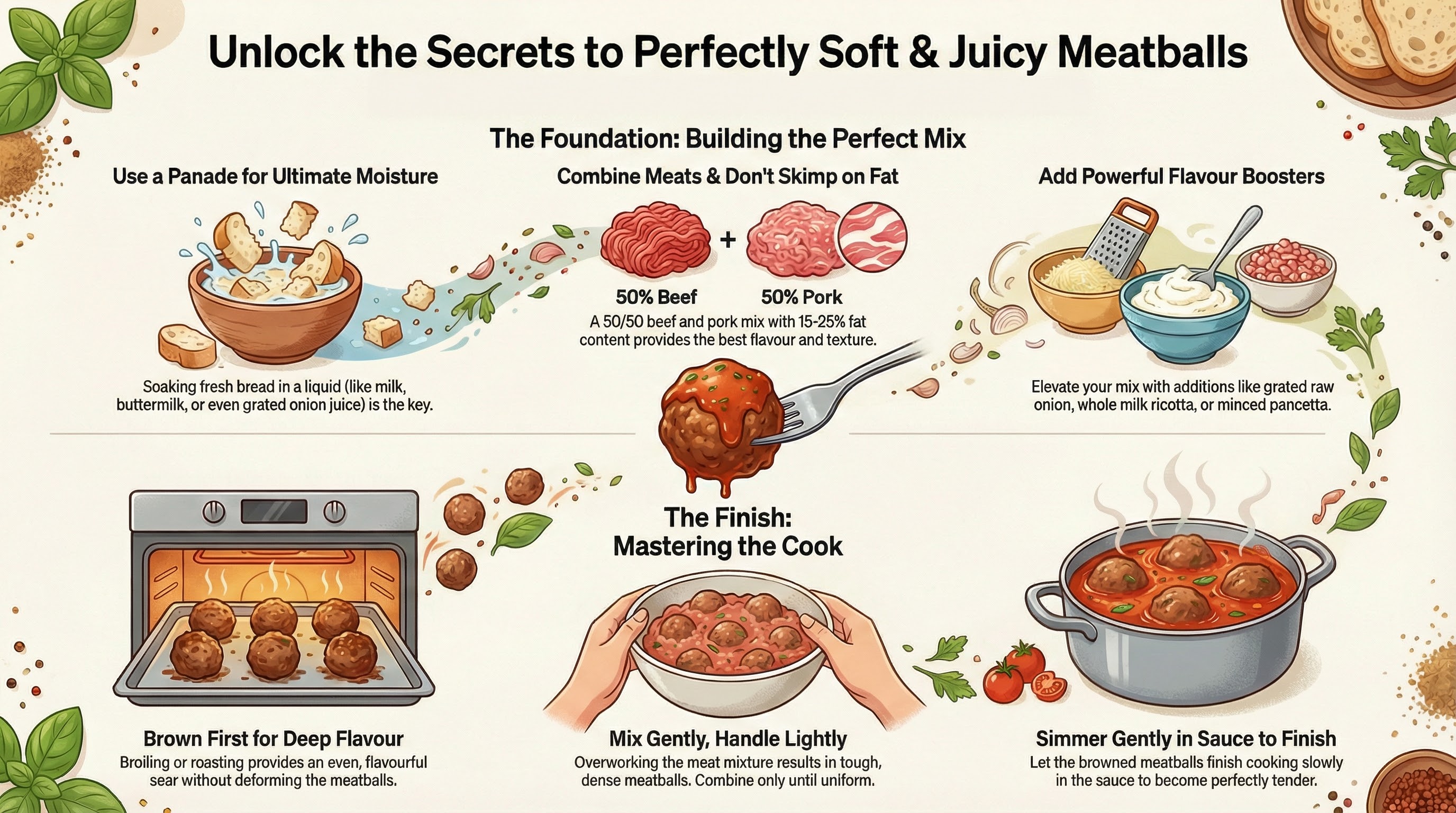
The 50/50 beef and pork split exists for a reason. Beef brings the structure and that deep, meaty backbone you want. Pork? That's your fat and tenderness. One without the other and you're compromising.
Here's where people mess up constantly: they buy the leanest mince they can find. But in meatballs, fat is doing serious work. It melts during cooking, bastes the meat from the inside, keeps everything lubricated. You want at least 15-20% fat content. Aim for 80/20 on both the beef and pork.
The 6 Pillars of Meatball Perfection
Most recipes tell you what to do - not why it works. And the why matters, because once you understand it, you can adapt to whatever's in your fridge.
1. The Binder Matrix (The Panade)
You've probably heard of a panade - that starch-plus-liquid mixture that goes into the meat. When meat cooks, the proteins tighten and squeeze out moisture. The panade interferes with this process. The starch gets in between those protein strands, physically blocking them from binding too tightly.
"The panade is the difference between a burger and a meatball." Write it down.
- •White bread (crusts removed): The classic. Gives you that soft, pillowy texture. Soak it in milk until it's completely falling apart.
- •Panko or crackers: Better for structure. Meatballs hold shape more firmly - slightly denser, but not in a bad way.
- •Ricotta cheese: Secret weapon for gluten-free. Creates meltingly tender texture.
- •Cooked rice: Traditional in Mexican albondigas. Different texture profile worth experimenting with.
2. The Umami Bomb: Building Complexity
Garlic and parmesan are doing good work. But there's a whole world of flavour builders that take meatballs from "good" to "what is in these?"
- •Anchovy paste or fish sauce: A tiny bit - half a teaspoon - dissolves completely. You won't taste fish. What you will taste is deep, savoury richness that mimics hours of slow cooking.
- •Finely minced pancetta: Stir into raw mixture. As meatballs cook, you get little pockets of rendered fat throughout.
- •Gelatinised stock: Mix concentrated stock into meat mixture. As it cooks, you get exploding juiciness like soup dumplings.
3. The Sacrificial Meatball: Your Insurance Policy
If you're rolling your entire batch without testing first, you're gambling. Once that mixture is cooked, there's no fixing underseasoned meatballs.
Pinch off a tablespoon-sized piece, flatten it into a patty, fry it quickly. Taste it. Is it salty enough? More garlic? This is the only safe way to adjust seasoning in raw meat. Takes two minutes. Saves your entire batch.
4. The Chill Factor: Why Cold Matters
Ever try to roll meatballs and end up with meat stuck all over your hands? That's a temperature problem. Warm fat is soft and sticky.
Refrigerate your mixture for 30-60 minutes before rolling. This solidifies the fat, making the mixture firmer and way easier to handle. Your meatballs will actually stay round instead of slumping into weird oval shapes.
5. Texture Profiling: Bake, Broil, Fry, or Poach?
- •Pan-frying: Maximum crust development. Gorgeous brown exterior, deepest flavour. Messy, requires attention, cook in batches.
- •Broiling: The compromise. High heat sears outside without stovetop splatter. Nice crust, less cleanup. 10-12 minutes.
- •Baking: The convenience play. Hands-off, even cooking. Less browning, softer exterior.
- •Poaching in sauce: Cloud-like tenderness with zero crust. Meatballs absorb sauce as they cook. Traditional Italian approach.
Recommendation: Broil to get a sear, then finish in the sauce. Best of both worlds.
6. Precision Cooking: The 145F Rule
"Cook until browned" or "cook until done" are not helpful instructions. Visual cues are unreliable. A meatball can look perfect outside and be raw or overcooked inside.
Pull your meatballs at 145F (63C). Carry-over cooking takes them another 5-10 degrees as they rest. Plus, finishing in sauce continues cooking. If you wait until 160F+, you've already lost - the proteins have squeezed out their moisture.
The Sauce & Serving: Because Context Matters
Finishing your meatballs in the sauce is non-negotiable. During that simmer time, the meatballs release flavour and fat into the sauce, enriching it. The sauce penetrates the meatballs, flavouring them throughout. They become one thing rather than two separate components.
Give them at least 20 minutes in there, ideally 30. Low simmer. Don't rush this part.
- •Classic spaghetti: Toss the pasta directly in the sauce - don't dump sauce on top of naked noodles.
- •Polenta or mashed potatoes: Cozy in a way spaghetti isn't. Different vibe.
- •Crusty bread: Traditional Italian polpette approach. Meatballs, sauce, good bread. Sometimes simple is perfect.
Storage, Freezing & Batch Cooking
- •Refrigerator: Cooked meatballs in sauce keep 3-4 days. Flavour actually improves after a day or two.
- •Freezing raw: Shape, place on parchment so they don't touch, freeze until solid, transfer to bag. Flash-freeze prevents clumping. Keeps 3-4 months.
- •Freezing cooked: Freeze in the sauce. Liquid acts as moisture barrier preventing freezer burn.
- •Reheating: Thaw in fridge overnight, reheat gently in covered pan on low. Don't microwave on high - you'll get rubbery exteriors and cold centers.
Key Reminders
- •Always cook a sacrificial meatball to test seasoning
- •Pull at 145F - they'll finish cooking in the sauce
- •The panade is the difference between a burger and a meatball
- •Chill the mixture before rolling for easier handling
- •Finish in sauce for at least 20 minutes
The Ultimate Homemade Meatballs
Tender, juicy meatballs using the panade technique and 50/50 beef-pork blend. The sacrificial meatball method ensures perfect seasoning every time.
Prep Time
25 mins
Cook Time
40 mins
Total Time
65 mins
Servings
6 servings (about 24 meatballs)
Ingredients
- •1 lb (450g) ground beef (80/20)
- •1 lb (450g) ground pork
- •2 slices white bread, crusts removed, torn into pieces
- •1/2 cup (120ml) whole milk or buttermilk
- •1 large egg
- •1/2 cup (45g) freshly grated Parmesan cheese
- •1 medium onion, grated
- •4 cloves garlic, minced
- •2 tablespoons fresh parsley, finely chopped
- •1/2 teaspoon anchovy paste or fish sauce (optional but recommended)
- •1 teaspoon kosher salt
- •1/2 teaspoon black pepper
- •4 cups marinara sauce, for finishing
Instructions
- 1
Make the Panade
Combine torn bread and milk in a small bowl. Let soak 5-10 minutes, then mash into a paste. This is the secret to tender meatballs - the starch blocks protein strands from binding too tightly.
- 2
Combine the Mixture
In a large bowl, add both meats, the panade, egg, Parmesan, grated onion, garlic, parsley, anchovy paste, salt, and pepper. Mix gently with a claw hand motion until just combined. Do not overmix - you want cohesion, not a workout.
- 3
Chill the Mixture
Cover and refrigerate for 30-60 minutes. This solidifies the fat, making the mixture firmer and easier to handle. Your meatballs will stay round instead of slumping.
- 4
Test with Sacrificial Meatball
Fry a small piece of the mixture to taste for seasoning. This is the only safe way to adjust seasoning in raw meat. Adjust salt and pepper if needed before rolling the entire batch.
- 5
Shape the Meatballs
Using a 1.5 tablespoon scoop for consistent portions, roll the mixture gently into balls. Uniformity ensures even cooking times. Don't compress - just round them out.
- 6
Broil Until Browned
Place on a foil-lined sheet pan. Broil 6 inches from heat for 10-12 minutes, turning once, until browned and internal temperature reaches 145F (63C). Pull early - they'll continue cooking.
- 7
Finish in Sauce
Add meatballs to simmering marinara sauce. Cook on low for 20-30 minutes. This is non-negotiable - the meatballs release flavour into the sauce while absorbing it. They become one thing.
- 8
Serve
Serve over pasta (toss it in the sauce first), polenta, mashed potatoes, or with crusty bread for soaking up the sauce.
Frequently Asked Questions
Why are my meatballs tough?
Two likely culprits: your meat was too lean, or you over-mixed. Fat keeps things tender - make sure you're using at least 15-20% fat content (80/20 ground meat). When combining ingredients, mix with a light hand using a claw motion. You want cohesion, not a workout. Over-mixing develops gluten and creates dense, sausage-like texture.
Can I bake meatballs instead of broiling?
Absolutely. Baking at 400F for 20-25 minutes works well. You won't get as much crust, but the texture will be softer and it's way less hands-on. Broiling is a nice middle ground if you want some browning without the stovetop mess. Pan-frying gives maximum crust but requires more attention.
Do I have to use breadcrumbs?
No - and actually, fresh bread soaked in milk (the panade method) is preferred. Breadcrumbs can make meatballs grainy. Fresh bread gives a smoother, more tender texture. For gluten-free, ricotta cheese creates a meltingly tender texture. Cooked rice works for Mexican albondigas style.
Can I use turkey instead of beef and pork?
You can, but turkey is very lean. You'll need to compensate by increasing your panade ratio and adding extra fat (a tablespoon of olive oil or butter mixed in). Some people add grated zucchini for moisture. Otherwise you're setting yourself up for dry meatballs.
How do I know when meatballs are done?
Internal temperature - 145F (63C). Get a digital instant-read thermometer. Visual cues are unreliable - a meatball can look perfectly done outside while being raw or overcooked inside. Pull at 145F because carry-over cooking and finishing in sauce will bring them to final temperature.
What is a panade and why is it important?
A panade is a starch-plus-liquid mixture (bread soaked in milk) that goes into the meat. When meat cooks, proteins tighten and squeeze out moisture. The starch gets between protein strands, physically blocking them from binding too tightly. The result is meat that stays soft even when fully cooked. As the saying goes: the panade is the difference between a burger and a meatball.
How do I freeze meatballs?
For raw: shape meatballs, place on parchment-lined sheet so they don't touch, freeze until solid, then transfer to freezer bag. This flash-freeze method prevents clumping. For cooked: freeze them in the sauce - the liquid acts as moisture barrier preventing freezer burn. Both keep 3-4 months.
Topics covered in this guide: